Technical Architecture
A comprehensive overview of QAPIShield's enterprise-grade backend infrastructure, designed for security, scalability, and HIPAA compliance.
Two-System Model
QAPIShield operates alongside your existing EHR using a privacy-preserving two-system model. The EHR maintains patient identity and clinical documentation, while QAPIShield tracks risk predictions and QAPI analytics using de-identified Resident Reference IDs.
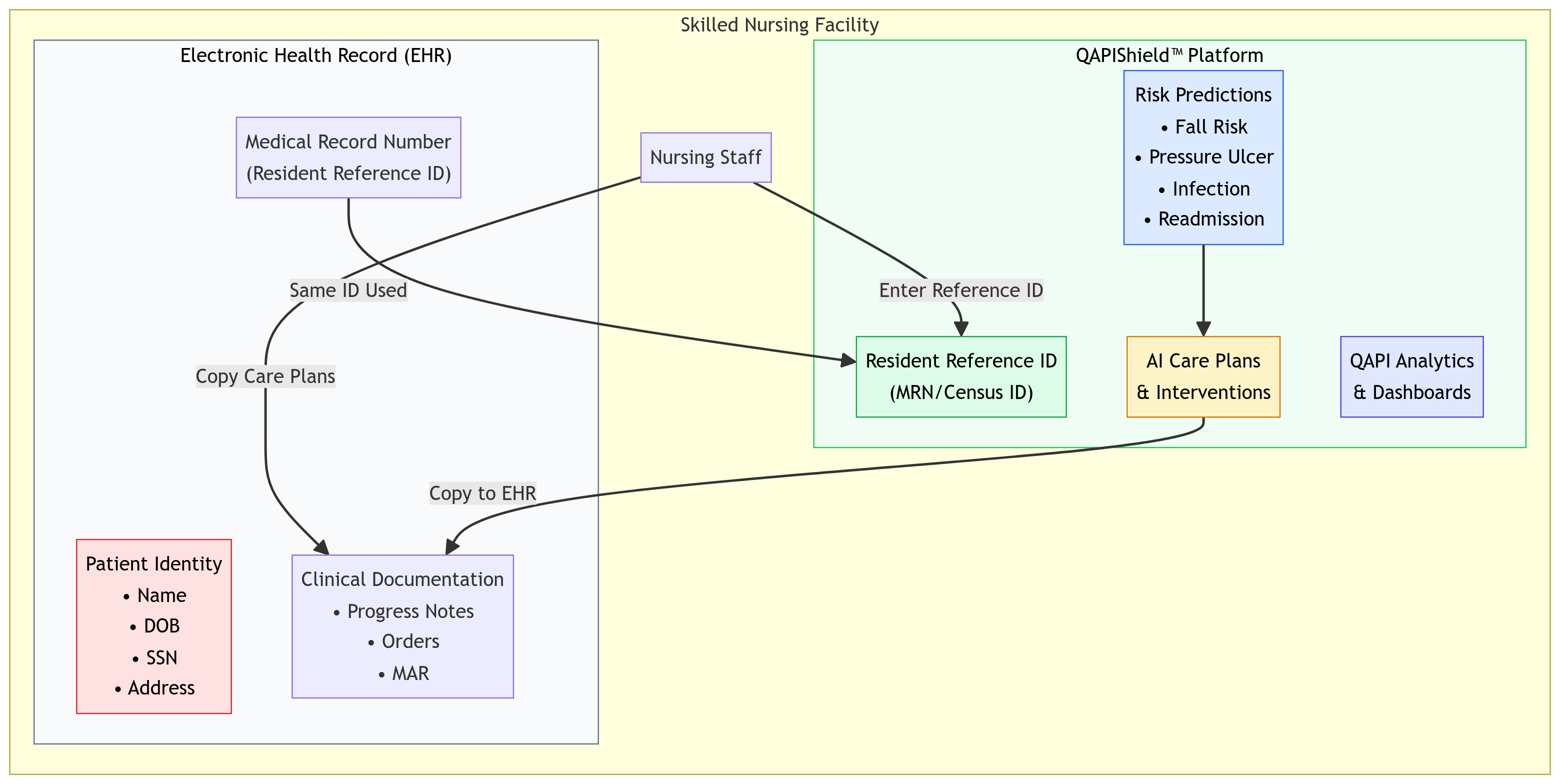
EHR System (PHI)
- Stores patient names, DOB, SSN, addresses
- Maintains clinical documentation and orders
- Generates Medical Record Numbers (MRN)
QAPIShield (De-identified)
- Uses only Resident Reference IDs (MRN/Census ID)
- Generates risk predictions and care plans
- Produces QAPI analytics and dashboards
System Components
Frontend UI
- User-facing interface
- Assessment forms
- Dashboard views
- QAPI report views
Backend API (Node.js)
- REST/JSON API
- Authentication & authorization
- Risk scoring endpoints
- Care plan generation endpoints
Database (PostgreSQL)
- Multi-tenant architecture
- Resident risk data
- Assessment records
- Risk scores & interventions
- Care plans & QAPI reports
- Audit logs
AI Layer
- Care plan + intervention text generation
- Uses de-identified clinical data only
- Connects to HIPAA-supporting AI model
Background Workers
- Scheduled QAPI report generation
- Analytics aggregation
Security / HIPAA
- Encrypted at rest + in transit
- Role-based access controls
- Audit logging
- No PHI sent to third-party AI
Database Schema Overview
QAPIShield uses a relational PostgreSQL schema with multi-tenant isolation. All tables are designed for HIPAA compliance with no PHI stored.
Database Tables
facilitiesSNF accounts
usersStaff at each facility
residentsPseudonymous resident records (NO PHI)
conditionsChronic conditions per resident
assessmentsClinical risk assessments
risk_scoresFall/ulcer/infection/readmission scores
interventionsSuggested actions
care_plansGenerated care plan text
qapi_reportsMonthly QAPI outputs
audit_logsHIPAA-compliant activity tracking
subscriptionsFacility billing
Key Relationships
facilities → 1:N → users, residents
residents → 1:N → assessments, conditions
assessments → 1:1 → risk_scores
risk_scores → 1:N → interventions, care_plans
API Endpoints
All endpoints require authentication and enforce facility-level isolation.
| Method | Endpoint | Description | Auth |
|---|---|---|---|
| POST | /assessments | Submit resident clinical data | Required |
| POST | /risk-score | Return risk levels (low/mod/high) | Required |
| POST | /care-plan | Generate narrative care plan | Required |
| GET | /dashboard | Facility-level analytics | Required |
| GET | /qapi-report | Monthly overview | Required |
POST /api/risk-score
Authorization: Bearer <token>
Content-Type: application/json

{
  "resident_id": "res_123",
  "facility_id": "fac_456",
  "assessment_data": {
    "age_range": "75-84",
    "mobility_status": "limited",
    "fall_history": true,
    "skin_integrity": "at_risk"
  }
}Risk Engine
QAPIShield's proprietary risk engine combines clinical rules with AI-powered analysis to produce consistent, survey-ready outputs.
Risk Scoring Components
Clinical Rules
Braden-like scoring, fall factors, vitals trends
Weighted Scoring System
Evidence-based factor weighting
Threshold-Based Alerts
Low / Moderate / High risk classification
AI-Generated Narratives
Survey-ready explanations and care plans
Risk Categories
HIPAA & Security Layer
PHI Stays Local
All PHI remains in the facility's secure environment
De-identified AI
Only de-identified data goes to AI models
Encryption
TLS 1.2+ in transit, AES-256 at rest
RBAC
Role-based access controls
Audit Logs
Full activity tracking for compliance
Deployment Architecture
Frontend UI
React SPA
Secure API
Node.js + Express
PostgreSQL DB
Multi-tenant
AI Engine
De-identified only
QAPI Reports
Survey-ready
JWT + Session Management
Scheduled Reports & Analytics
HIPAA Compliance Tracking